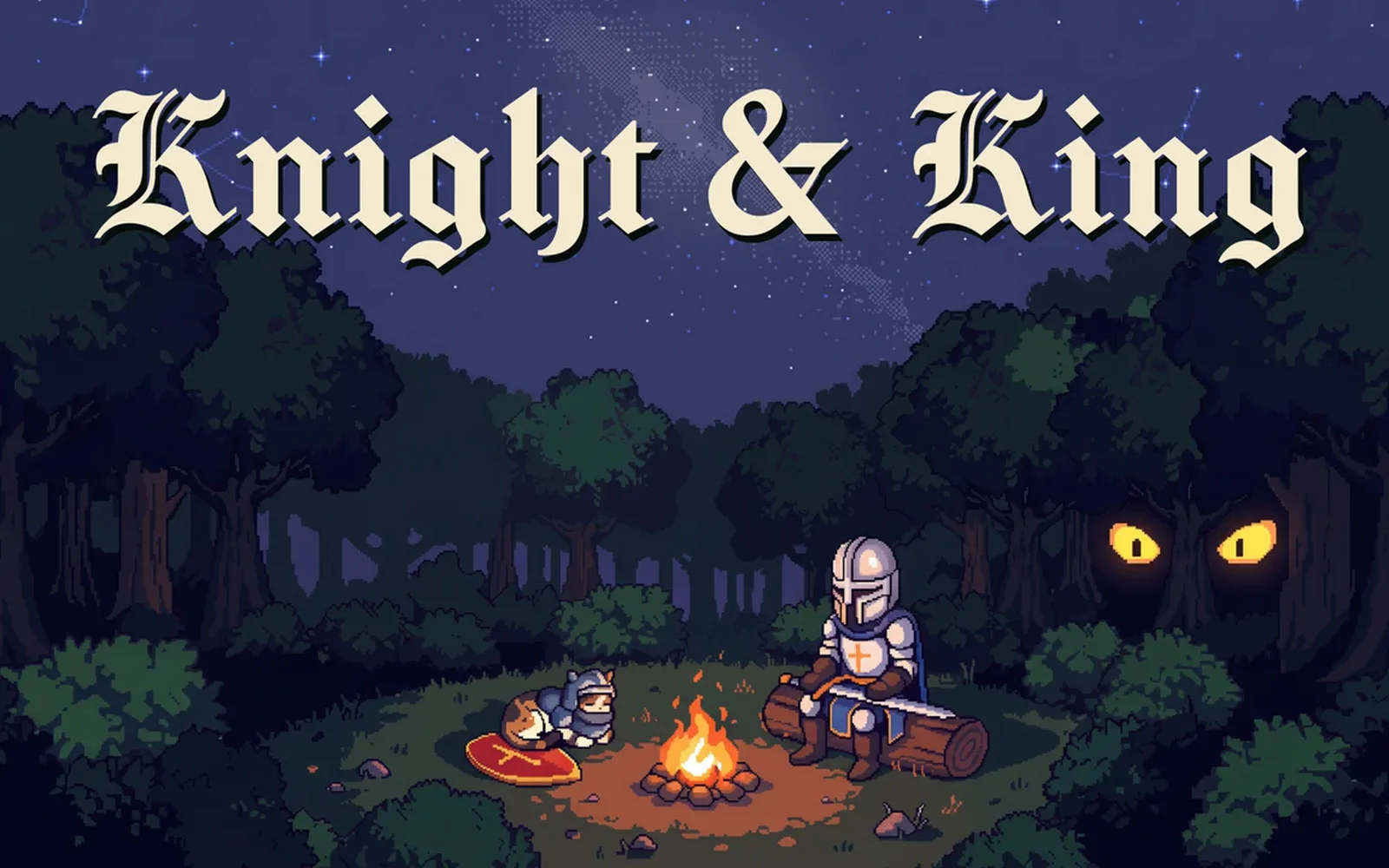
Knight & King

Role

Game designer & art director ⁠— concept, systems, art direction and approval of every image and sound; built with Claude Code, PixelLab, Higgsfield and ElevenLabs

Client

—

Disciplines

Game design · Pixel art direction · Systems design · Godot · Playtesting

Year

2026

A pixel-art strategy game: one knight, a ruined border castle and monster contracts on a Heroes-style day map. Version 1.0 has two acts, three regions and five bosses, and runs in a browser, phones included

Status
Release 1.0 since 28 October 2026: two acts of 56 days each, playable start to finish at play.ontwrpn.com. A handful of people have played it; the formal five-player playtests have not been run
Idea
Witcher contracts on a Heroes map with Zelda bosses: a day-and-turn world map, a castle in cutaway like Fallout Shelter, and every fight in a separate action arena
Method
Build in stages, each with a written plan, a review of every task and a log of the decisions and their reasons. Balance is set by a scripted knight who plays every boss the same way each time
Built
Three regions, five bosses, a siege, a dragon, nine skills, fourteen story cutscenes, music and sound; 424 commits and 2,205 automated tests in eight weeks

A strategy game where the hero is the only unit

In Heroes of Might and Magic a hero is a token that carries an army. Knight & King turns that round: the player is one knight, and the kingdom grows around him. Villages post contracts on monsters, as in The Witcher; the knight walks there on a world map that runs in days and movement points; the fight itself opens as a separate arena with telegraphed attacks and a boss, closer to 2D Zelda than to a strategy battle screen. Between contracts the castle is seen in cutaway, room by room, the way Fallout Shelter shows its vault.

King is the knight’s cat, in armour, and the kingdom is his. The joke is that nobody in the game finds this strange. The name won over nine others; a search on Steam found King ’n Knight, a medieval platformer with the same two words reversed, and the risk is written down rather than ignored.

A minute of the 1.0 build: the knight walks to a contract, then the Barrow Lord, the Ashen Heights, the siege at the castle wall and the dragon. The fights are played by the scripted knight that sets the balance; sound on in the controls

From a slice to a whole game in a week

On 21 October 2026 Knight & King was a vertical slice: one castle, one map, one troll, a contract due on day 6. The first people who played it on their phones said two things: the real-time fight works, and the game is too short. The first settled the riskiest question in the design, whether action combat belongs in a strategy game on a phone; the second set the plan for the next week.

Release 1.0 went live on 28 October. Act 1 is 56 days at home and in the Fells: template contracts that refill, levels, wounds and a Chapel to heal them, an Alchemist whose oils double the damage against the monster that is weak to them, a scout who finds out which, night events and ambushes, and two bosses, the Troll Chief and the Barrow Lord. Act 2 is 56 more days in the Ashen Heights: Steadfast villages that trade, an orc warband that marches on the castle for eleven days, a siege on the castle wall and a dragon that strikes villages until the knight drives it off and finally kills it on its peak.

The test of a stage was a playable build at the end of it, not a document

One map, three regions

The world map is one painted panorama that scrolls sideways and grows as the campaign does: the green home valley, the Fells beyond a pass that opens after the Troll Chief, and the Ashen Heights in Act 2. The knight walks along roads traced by hand, so he never cuts through a house; the top bar always says what is next, where, for whom and by which day.

Day 24 at home. The top bar turns the contract into a route: four moves, two roads, five days left

The Fells, open after the Troll Chief: moor, barrows and two villages that have paid no tithe in years

The Ashen Heights in Act 2: the Orc Camp, the Drake Spires and Dragon’s Peak

Every evening ends on a report, and every report ends on tomorrow: what the scout found, what the villages paid, what is due. A tap on Map, or M, opens the same world as a schematic in ink. At levels 3, 6 and 9 the castle asks for a choice of one skill out of three.

The day report: the scout’s news, the takings and tomorrow

A skill at level 9: three cards, no cancel, and each one changes how the fight is played

Five bosses, each with one thing to learn

Every boss teaches one thing. The troll winds up and turns orange before a slam, long enough to dodge. The Troll Chief charges in a straight line, so the answer is a step to the side. The Barrow Lord calls crows that dive at the knight while he is busy with the Lord. The Orc Warlord comes with the third wave at the castle wall and blows a horn that calls in more raiders. The dragon swoops, claws and breathes a band of fire across the field; it has to be driven off from the villages it burns before it can be fought on its peak.

The Barrow Lord, weak to silver oil

The siege: three waves on the castle wall, the Warlord with the last

The dragon on its peak, a dark silhouette on the ashen ground; its mouth glows before it breathes

The balance is not set by feel alone. A scripted knight plays each boss through the knight’s own controls, by four plain rules: raise the shield toward a telegraphed blow, close in, swing once, take the crow first. It runs at a fixed frame rate, so a fight with the same seed is the same fight every time, and the automated tests pin the result: the steady knight with the right oil beats the Barrow Lord with a quarter of his health left. When the dragon was too easy, its health was doubled to 1,800 and the run said so before any player did.

Fourteen cutscenes the spec said not to make

The design spec said no cutscenes. After Act 1 was built I asked for them anyway: the campaign had turning points that a line of text on a parchment did not mark. There are fourteen, each about five seconds and silent, with a two-line caption, from the burnt holding at the start to the two endings. The music keeps playing under them, ducked, and any press skips one. They download after the title screen, so the game does not wait for them.

Thirteen of the fourteen cutscenes in order, with the castle theme under them: the holding in ashes, the first troll, a night on the road, the Chapel and the Alchemist, the Troll Chief, the pass, the Barrow Lord and the good ending

“A night on the road. Something in the trees is watching.”

“Something stirs in the barrows. The Barrow Lord has risen.”

The stills were made in Higgsfield with Nano Banana Pro and turned into clips with Kling 3.0, kept in the game’s pixel look at a larger scale, so a story beat reads as the same world. The music and the sound came from ElevenLabs: five music loops for the title, the castle, the map, the fights and the bosses, three ambience beds, and the sound effects.

One style frame, then everything to match it

The first mocks were tiles and stickers on a plain background, and they read as an asset flip. So before any other asset, one whole 640 × 360 scene was generated as a style frame. Every asset after it had to match that frame: its palette, its outlines and its light. Two fonts, Jersey 10 and Jacquard 12, both under the Open Font License. One pixel size for the whole game, and no textured panel is ever stretched.

The style frame, chosen over an autumn variant of the same scene

Each new region kept to it. The Fells got moorland and barrows, the Heights ash, rock and a volcano; the foes are dressed by region, so a wolf at home is an ash hound in the Heights. The castle grew rooms as the villages paid for them, a Chapel, an Alchemist and Barracks, and the arena got a backdrop for each place: a forest clearing, a barrow, the castle wall, scorched ground under Dragon’s Peak.

The castle in Act 2: the treasury and goods on top, the rooms in cutaway, the board below

The title screen, on the troll key art

Art for the game, not from it

The pictures in this section and the cover at the top of the page are key art, not screens from the game. Higgsfield generated them, using the style frame and the knight, King and troll sprites as references; I chose the scenes, turned down the ones where King grew to a giant or merged with the knight’s helm, framed them and set the title in Manufacturing Consent in Figma.

The troll from the arena, three times the knight’s height, with the orange glow of his wind-up

King trots ahead on the road out of the village, as if he were leading

The knight and King at sunset over the kingdom

Played by thumb

Mouse and keyboard, touch and gamepad have been supported since the first day, and the game runs as a web build so that nobody needs an app or a particular phone. The fight was rebuilt after I played it on my own phone: the sword hit from too far, so its reach now matches the blade drawn in the frames; I wanted to defend, so the shield became a held block that stops blows from the front and costs stamina; the buttons grew to thumb size. A “How to fight” card opens the first fight, worded for the device in hand.

Arriving at a lair asks first: the reward, the knight’s health, the oil it is weak to, and how long it can wait

Drakes in the Heights: the same three actions, strike, dodge and block, in every fight

Passes on a real iPhone, where Safari leaves the game a window of 734 × 283, found what no emulator did: room names too small to read, a save mark sitting on the report’s frame, an army on the map hidden under the top bar. The game autosaves as it goes and marks it on screen, and a closed tab comes back to the same moment, even in the middle of a fight. Added to the Home Screen, it opens without the browser’s bars.

Who did what

I’m using Claude Code in development; PixelLab generated the sprites, rooms and painted scenes, Higgsfield the key art and the cutscenes, ElevenLabs the music and the sound. I decided what the game is: the structure of a Heroes map with a separate action arena, the chibi proportions, the cat, the name, the order of the stages, the shield, the cutscenes, dropping the horse for a dragon, and which images and sounds ship. Every call made while building is logged with its reason and what it would cost if it is wrong, so I could check it later on my phone.

A lot of the direction was saying no. I turned down two painted parchment maps because they were not schematic enough, so the overview is composed in code from small ink icons. I turned down a breathing loop and a tail flick for King, who sits still. On my phone I read a pale destination as “the knight doesn’t go there” rather than “you can’t afford it”, so unaffordable places now get a red ring and the top bar says why.

What’s next

Run the playtests with outside players that the gates always asked for, five people each, and write down the result against the numbers fixed in advance, whichever way it goes. Until then the balance rests on one scripted knight and my own play. After that: a third act only if the players ask for more, and a store page.

play.ontwrpn.com — live preview
Live demo
play.ontwrpn.com
Open

Knight & King 1.0 ⁠— mouse and keyboard, touch or gamepad. Landscape on a phone

Next project
True Cost of Flying